



Preserving ancient dances in the far West
In the evening in Tả Kố Khừ village, Sín Thầu commune, the sound of music echoes in the small courtyard. Under the electric light, Hà Nhì women rhythmically practice every movement of an ancient dance. In the middle of the dance circle, Pờ Sơn Mé adjusts the movements for the members while reminding them of every footstep and how to rotate their hands correctly according to the traditional dance of their people.
Born in 1992, Pờ Sơn Mé is the Captain of the Tả Kố Khừ village Performing Arts Team with 12 members. With more than a decade of attachment to the Performing Arts Team, she understands that for traditional culture not to be lost, the first thing is to maintain the atmosphere of regular cultural activities in the community. Mé shared that in the past, she followed grandmothers and mothers to watch dances and fell in love with them at some point without even knowing. Now that life has changed so much, if they do not regularly practice and perform, many ancient dances will gradually be forgotten.
Since taking on the role of Captain in 2020, Mé and the members have maintained regular practice during free evenings. What concerns her is that many ancient dances of the Hà Nhì people are gradually being fully remembered by fewer people. The elderly artisans are getting older day by day, so she proactively invites the elderly women in the village to instruct and restore every ancient dance movement. Thanks to this, dances such as “Vui sản xuất” (Joy of Production), “Á mì sơ”, “Duyên dáng Hà Nhì” (Hà Nhì Charm), and “Vũ điệu Hà Nhì” (Hà Nhì Dance) continue to be preserved and performed at local cultural events and festivals.
The Tả Kố Khừ village Performing Arts Team is frequently invited to participate in provincial cultural, tourism, and festival events, performing for tourists visiting the area. The dances bearing the cultural identity of the Hà Nhì people have been introduced by the village’s Performing Arts Team in Hanoi and Hồ Chí Minh City during programs promoting the image of Điện Biên’s land and people. Hà Nhì women in traditional costumes and dances imbued with the breath of the far-western mountains and forests have left many impressions on tourists.
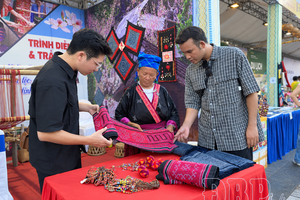
Preserving culture through the art of dancing, Pờ Sơn Mé also quietly preserves the ethnic identity through every stitch by sewing traditional Hà Nhì ethnic costumes. Learning the craft of embroidery and sewing from grandmothers and mothers, she opened a shop tailoring and renting Hà Nhì costumes. Each outfit takes more than a month to complete, with many stages requiring meticulousness and skill. Mé confided that making handmade items takes a very long time, but she still wants to keep the old methods. The most beautiful traditional costume is the one made with the dedication and care of its creator. Hà Nhì dresses and shirts are now not only for the Hà Nhì people themselves but have also become favorite products for tourists visiting Sín Thầu. For Pờ Sơn Mé, that is also a way for ethnic culture to naturally be present in today’s life.
.jpg)
Spreading culture in the digital space
If Pờ Sơn Mé preserves culture through dances and traditional embroidery, Quàng Văn Đạt in Búng Lao commune chooses social media as a space to spread his ethnic identity. Graduating with a major in journalism and currently working in Điện Biên, Đạt joined the Điện Biên provincial Thai Ethnic Cultural Association and is currently the Head of the Association’s Communications Division. For Đạt, young people today have many advantages in bringing traditional culture closer to the community through digital platforms. Instead of rigid dissemination methods, Đạt and the members of the Communications Division build relatable content on the Association’s fanpage. Videos learning the Thai script, images of traditional costumes, cultural activities, and the daily life of the Thai people are regularly posted, attracting the attention of many young people.
Two online photo contests, “Golden Season in the Thai village” and “Spring Colors in the Thai village,” organized by Quàng Văn Đạt and the Communications Division in late 2025 and early 2026, created positive effects. The first contest attracted over 30 participating authors, while the latter received responses from nearly 200 authors. Photos of the ripe rice season, traditional costumes, and the everyday activities of the Thai people were widely shared on social media, helping many young people love and take more pride in their ethnic culture.
As a result, the fanpage of the Điện Biên provincial Thai Ethnic Cultural Association grew from 5,000 to over 13,000 followers in just a short time. According to Đạt, the good news does not lie in the numbers, but in the fact that increasingly more young people proactively interact, learn about, and share content related to ethnic culture. Quàng Văn Đạt shared that as a young Thai person, he is dedicated to activities preserving, promoting, and spreading the beauty of Thai culture to everyone. In the coming time, he will continue to advise on communication activities for the Association, build a more developed fanpage, and simultaneously develop his personal Facebook and TikTok channels to spread the beauty of Thai culture in a way suitable for today’s youths.
In many localities within the province, there are increasingly more young people choosing to return to their ethnic culture. For instance, Lò Chúc Chi, Director of the Hoa Ban Trắng Cooperative in Mường Lay ward, develops the traditional “khẩu xén” and “chí chọp” cakes of the Thai people; Lù Thị Toản, Director of the Quan Chiêng Community Tourism Cooperative in Mường Lay ward; and Thùng Thị Lâm, Head of the Management Team of the Nà Sự Village Community Tourism Destination in Mường Chà commune, preserve and promote ethnic cultural identity through tourism activities.
Each person has a different approach and a different direction, but what they have in common is their love for ethnic culture and the desire that traditional values will not be forgotten amidst modern life. Amidst the new pace of life, traditional culture can only exist sustainably when continued with love and responsibility. And in Điện Biên, young people are contributing so that traditional cultural values continue to be present in today’s life and are preserved and passed on to the future.
Nguyễn Hiền
.jpg)
.jpg)
.jpg)
.jpg)
.jpg)
.jpg)
.jpg)
.jpg)
.jpg)
.jpg)
You have 500/500 characters left
Please enter 5 or more characters!!!